Surrogacy laws by state: where the US actually stands in 2026
Which US states allow surrogacy in 2026, with the statute for each: where marriage or a genetic link is required, and where it is a crime.
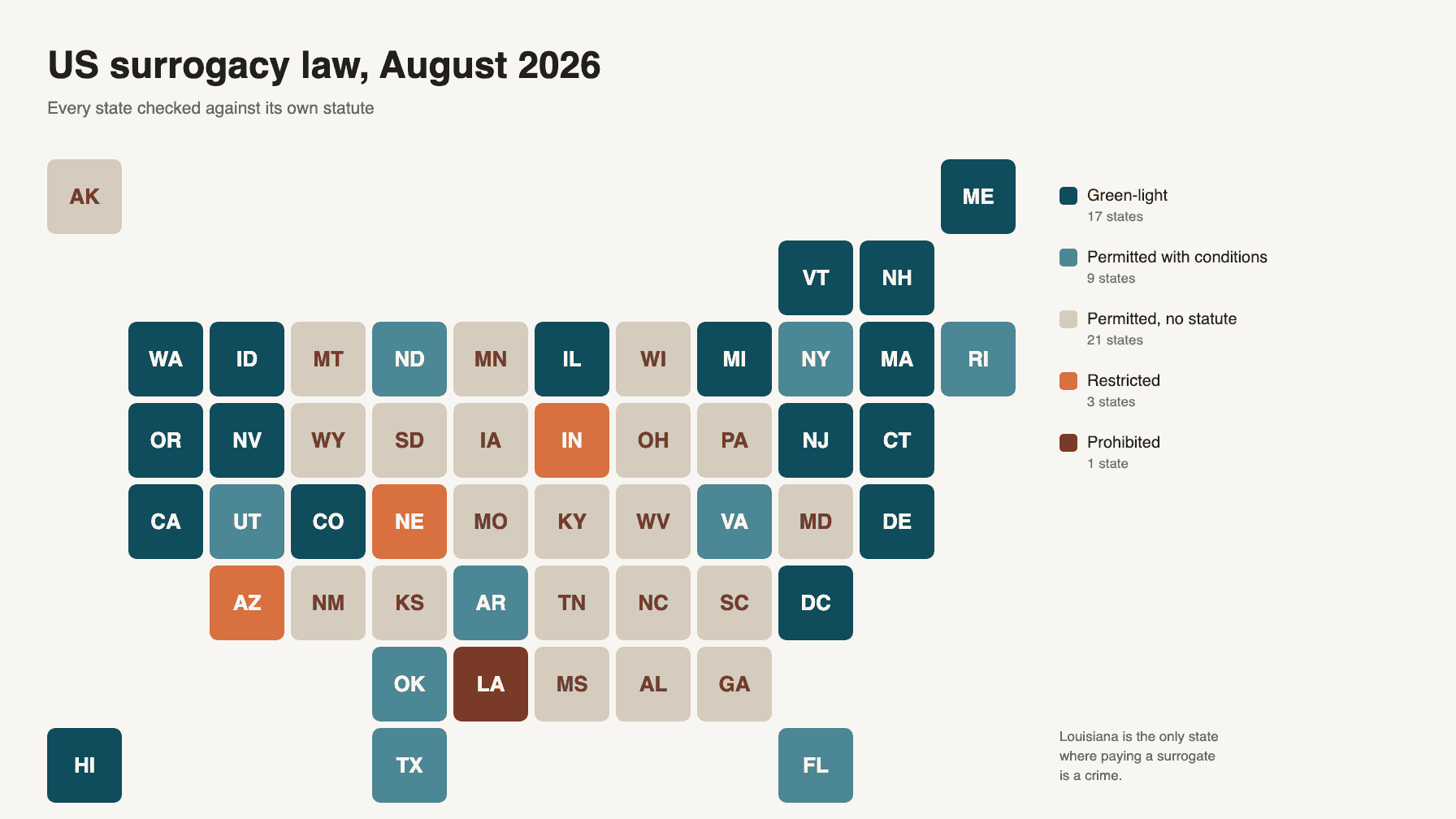
The state that decides your case is the one where the surrogate lives and gives birth, not the one where you live. Parentage orders come from her state's courts. Everything below is the law in force today, verified against each state's official code on 7 August 2026.
Where each state stands
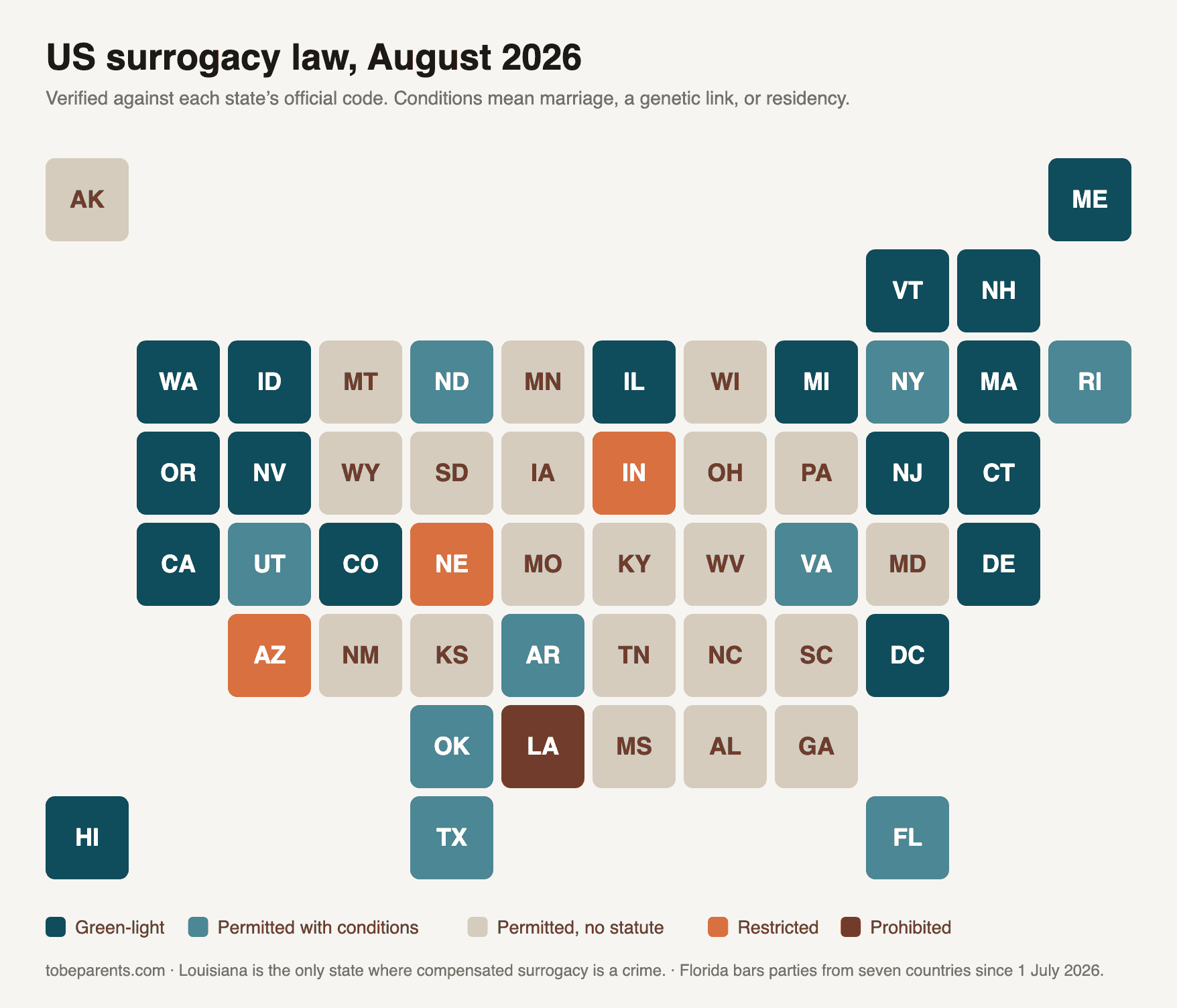
Five categories. The difference that matters is not whether surrogacy is allowed, but whether the statute attaches a condition you cannot plan around.
- Green-light. A statute protects compensated gestational surrogacy, with no marriage or genetic-link requirement. California, Colorado, Connecticut, Delaware, District of Columbia, Hawaii, Idaho, Illinois, Maine, Massachusetts, Michigan, Nevada, New Hampshire, New Jersey, Oregon, Vermont, Washington.
- Permitted with conditions. A statute allows it but excludes some families. Arkansas, Florida, New York, North Dakota, Oklahoma, Rhode Island, Texas, Utah, Virginia.
- Permitted, no statute. Surrogacy happens and orders are granted, but the rules come from case law and county practice. Alabama, Alaska, Georgia, Iowa, Kansas, Kentucky, Maryland, Minnesota, Mississippi, Missouri, Montana, New Mexico, North Carolina, Ohio, Pennsylvania, South Carolina, South Dakota, Tennessee, West Virginia, Wisconsin, Wyoming.
- Restricted. A statute declares the contract void. Nobody is prosecuted, but the contract cannot be enforced. Arizona, Indiana, Nebraska.
- Prohibited. Compensated surrogacy is a crime. Louisiana.
Where the Law column carries a link, we opened that text ourselves. "No statute" is not a gap in our research; it is the most important fact on the row.
| State | Category | Law | Notes |
|---|---|---|---|
| Alabama | Permitted, no statute | No statute | No surrogacy statute; the parentage act reserves a blank section and the adoption code exempts surrogacy. |
| Alaska | Permitted, no statute | No statute | Nothing in Alaska law permits or bans surrogacy, so everything depends on the judge you draw. |
| Arizona | Restricted | Ariz. Rev. Stat. § 25-218 | Statute bans surrogacy contracts and makes the surrogate the legal mother; plan to match elsewhere. |
| Arkansas | Permitted with conditions | Ark. Code Ann. § 9-10-201 | Statute favors surrogacy but routes parentage through the intended father, so others may need adoption. |
| California | Green-light | Cal. Fam. Code §§ 7960-7962 | One of the strongest surrogacy laws in the country; pre-birth judgments are routine for any family type. |
| Colorado | Green-light | Colo. Rev. Stat. §§ 19-4.5-101 to 19-4.5-114 | Modern 2021 act that needs a Colorado link such as residency, the birth, or the embryo transfer. |
| Connecticut | Green-light | Conn. Gen. Stat. §§ 46b-521 to 46b-538 | Fully inclusive law, but at least one party to the agreement must actually live in Connecticut. |
| Delaware | Green-light | 13 Del. C. §§ 8-801 to 8-813 | Compensated gestational surrogacy is protected; traditional surrogacy rules arrive on 6 December 2026. |
| District of Columbia | Green-light | D.C. Code §§ 16-401 to 16-412 | DC banned surrogacy until 2017; the current law allows paid agreements for any family structure. |
| Florida | Permitted with conditions | Fla. Stat. §§ 742.15, 742.16 | Married couples only, and since July 2026 no party may come from a listed foreign country. |
| Georgia | Permitted, no statute | No statute | No surrogacy statute, but courts routinely grant pre-birth orders, including for donor gametes. |
| Hawaii | Green-light | 2025 Haw. Sess. Laws Act 298 (S.B. 1231, H.D. 1) | Act 298 repeals HRS chapter 584; the new chapter number is assigned by the revisor. |
| Idaho | Green-light | Idaho Code §§ 7-1601 to 7-1612 | A court validates the agreement; the petition may be filed up to 7 days after the birth. |
| Illinois | Green-light | 750 ILCS 47/1 et seq. | The genetic-link rule ended in December 2025, so donor embryos now qualify. |
| Indiana | Restricted | Ind. Code §§ 31-20-1-1 to 31-20-1-2 | Contracts are void, yet surrogacy is not a crime and county courts do issue parentage orders. |
| Iowa | Permitted, no statute | Iowa Code § 710.11 | Section 710.11 exempts surrogacy from the felony ban on buying or selling a person. |
| Kansas | Permitted, no statute | No statute | Two old attorney general opinions call the contracts unenforceable, but courts still grant orders. |
| Kentucky | Permitted, no statute | Ky. Rev. Stat. § 199.590 | The statute bans paid traditional surrogacy only and never mentions gestational surrogacy. |
| Louisiana | Prohibited | La. Rev. Stat. §§ 9:2718 to 9:2720.15 | Only unpaid surrogacy is legal; paying a carrier exposes arrangers to criminal liability. |
| Maine | Green-light | 19-A M.R.S. §§ 1931 to 1939 | Intended parents hold full parental rights immediately at birth under a compliant agreement. |
| Maryland | Permitted, no statute | No statute | No surrogacy statute. Courts follow In re Roberto d.B. (2007) and routinely grant pre-birth orders. |
| Massachusetts | Green-light | Mass. Gen. Laws ch. 209C, §§ 28A-28P | Gestational surrogacy agreements are enforceable and courts can enter parentage judgments before birth. |
| Michigan | Green-light | Mich. Comp. Laws §§ 722.1701 to 722.1909 | Compensated surrogacy was a crime here until April 2, 2025 and now gets a pre-birth parentage judgment. |
| Minnesota | Permitted, no statute | No statute | No surrogacy statute; the 2024 assisted reproduction law expressly leaves surrogacy out of its scope. |
| Mississippi | Permitted, no statute | No statute | No statute. Surrogacy bills died in committee in 2025 and 2026, so county practice still governs. |
| Missouri | Permitted, no statute | No statute | No statute. Parentage judgments are normally entered within days after birth, not before it. |
| Montana | Permitted, no statute | No statute | No statute and no published case law. Judges grant pre-birth orders, usually with a genetic link. |
| Nebraska | Restricted | Neb. Rev. Stat. § 25-21,200 | A paid surrogacy contract is void, so no term of the agreement can be enforced in court. |
| Nevada | Green-light | Nev. Rev. Stat. §§ 126.500-126.810 | Parentage vests in the intended parents at birth and the court can validate the agreement first. |
| New Hampshire | Green-light | N.H. Rev. Stat. Ann. §§ 168-B:1 to 168-B:22 | A parentage order can be sought before birth and no hearing is needed if affidavits show compliance. |
| New Jersey | Green-light | N.J. Stat. Ann. §§ 9:17-60 to 9:17-68 | Compensated gestational surrogacy is protected by statute; single and unmarried parents qualify. |
| New Mexico | Permitted, no statute | N.M. Stat. Ann. § 40-11A-801 | No statute permits or bans it; courts routinely grant pre-birth parentage orders. |
| New York | Permitted with conditions | N.Y. Fam. Ct. Act §§ 581-101 to 581-705 (art. 5-C) | Compensated surrogacy is legal, but one side must have six months of New York residency. |
| North Carolina | Permitted, no statute | No statute | No statute at all; pre-birth orders are granted by county practice and vary by judge. |
| North Dakota | Permitted with conditions | N.D. Cent. Code §§ 14-18-01 to 14-18-09 | Only embryos made from both intended parents' gametes qualify; other deals are void. |
| Ohio | Permitted, no statute | No statute | No statute; the state supreme court upheld gestational surrogacy contracts in 2007. |
| Oklahoma | Permitted with conditions | Okla. Stat. tit. 10, §§ 557 to 557.25 | Two intended parents must be married to each other, and a court validates before transfer. |
| Oregon | Green-light | Or. Rev. Stat. §§ 109.222 to 109.244 | The 2025 parentage act made surrogacy agreements enforceable statewide from January 2026. |
| Pennsylvania | Permitted, no statute | No statute | No statute; the Superior Court enforced a gestational carrier contract in 2015. |
| Rhode Island | Permitted with conditions | R.I. Gen. Laws § 15-8.1-801 et seq. | At least one intended parent must live in the United States; no marriage or genetic link. |
| South Carolina | Permitted, no statute | No statute | A search of the official South Carolina Code finds no surrogacy law, so county practice controls. |
| South Dakota | Permitted, no statute | No statute | SDCL 22-17-14 covers coercing an abortion, not surrogacy; South Dakota has no surrogacy law. |
| Tennessee | Permitted, no statute | Tenn. Code Ann. § 36-1-102(52) | The statute only defines surrogate birth and states that it does not authorize the practice. |
| Texas | Permitted with conditions | Tex. Fam. Code §§ 160.751 to 160.763 | Section 160.754(b) requires intended parents to be married, so single people fall outside it. |
| Utah | Permitted with conditions | Utah Code §§ 81-5-801 to 81-5-809 | Still married couples only, and the old 78B-15 numbering that most sources give is out of date. |
| Vermont | Green-light | 15C V.S.A. §§ 801 to 809 | Compensation is allowed and intended parents are parents at birth whether or not related. |
| Virginia | Permitted with conditions | Va. Code §§ 20-156 to 20-165 | Any promise to pay the surrogate beyond medical and ancillary costs is void and unenforceable. |
| Washington | Green-light | RCW 26.26A.700 to 26.26A.785 | Compensation is allowed; each side needs medical and mental health screening and its own lawyer. |
| West Virginia | Permitted, no statute | W. Va. Code § 61-2-14h(e)(3) | One line exempts surrogacy fees from the baby selling crime, but there is no parentage framework. |
| Wisconsin | Permitted, no statute | Wis. Stat. § 69.14(1)(h) | Rosecky v. Schissel, 2013 WI 66, makes surrogacy contracts enforceable unless against a child's interest. |
| Wyoming | Permitted, no statute | No statute | A search of Wyoming's children and health statutes finds no surrogacy law, so county practice rules. |
The conditions that actually exclude people
Eight states have a statute that looks welcoming on a color map and shuts out a large share of the people reading this.
- Marriage required: Texas, Utah, Oklahoma (where there are two intended parents), Arkansas, Louisiana. A single person cannot use these statutes.
- Genetic link required: Utah, North Dakota, Louisiana. A family using both donor egg and donor sperm falls outside the statute even if married. Texas does not require this, which is why two states that look identical point in opposite directions for a donor-conceived family.
- Your own residency required: New York (six months on one side), Rhode Island (an intended parent must reside in the United States), Louisiana (all parties, 180 days). Residency rules that any party can satisfy, as in Michigan, Colorado, Hawaii, Connecticut and Vermont, are met by the surrogate simply living there.
Florida bars parties from seven countries
Since 1 July 2026, a gestational surrogacy contract may not be entered into in Florida "if any party to the contract is a citizen or resident of a foreign country of concern." Such a contract is "void and unenforceable as against the public policy of the state." The list is China, Russia, Iran, North Korea, Cuba, Venezuela and Syria.
- Citizenship or residence, either one. Holding the passport is enough.
- Any party, including the surrogate. One surrogate with a listed citizenship voids the contract even if both intended parents are American.
- No second route. Florida's preplanned adoption path was the fallback for families the married-couple rule already excluded. The same act closed it.
The statute carves out nothing for dual nationals, US citizens or permanent residents, so on a plain reading it catches them. No court has construed it yet.
Louisiana is the one state where this is a crime
A gestational carrier agreement is lawful in Louisiana only when all of these are true: the intended parents are a man and a woman married to each other; the embryo is made from their own gametes; the carrier and each intended parent have been domiciled in Louisiana for 180 days, which is a stricter test than simply living there; an independent board-certified physician in obstetrics and gynecology or in reproductive endocrinology, who has treated the intended mother long enough to judge her condition, files a signed affidavit that the transfer is medically necessary; a court approves before the transfer; and the carrier receives listed expenses only, with no fee. The domicile and affidavit requirements are La. Rev. Stat. § 9:2720.3(B), which defines "medically necessary" narrowly: the intended mother has been diagnosed infertile, or has a physical condition that would make pregnancy a serious risk of death or of substantial and irreversible impairment of a major bodily function beyond the risk customary to pregnancy and childbirth.
Entering a non-compliant agreement, or arranging or advertising one, carries a fine of up to fifty thousand dollars or up to ten years. Traditional surrogacy is unlawful whether paid or not, and the contract behind it is absolutely null rather than merely unenforceable (La. Rev. Stat. § 9:2719). A compensated contract signed in another state is still treated as null in Louisiana.
Matching across state lines
If your own state is restricted or prohibited, you match with a surrogate who lives and will deliver elsewhere. This is the standard path, not a workaround.
- The agreement specifies the delivery state's law.
- The clinic is in the delivery state, or coordinates with its courts.
- The pre-birth order is obtained there.
- Your names go on that state's birth certificate, which is recognized at home under Full Faith and Credit.
Budget for one trip for the transfer and two to four weeks around the birth.
Two changes already scheduled
Neither is in force today. From 6 December 2026 Delaware will also cover compensated traditional surrogacy, which almost no state does. The vital-records half of Oregon's parentage act follows on 1 January 2027.
How to check a state yourself
- Read the statute. The Law column links to it. Most state codes are free and searchable.
- Check the session index. Legislatures publish a list of which sections each session touched and whether the bill passed. It is the fastest way to see if your section was amended this year.
- Ask an attorney licensed in that state. The Academy of Adoption and Assisted Reproduction Attorneys keeps a directory.
- Distrust any map without a date on it. While preparing this guide we found a widely cited map running on 2022 data, a law firm describing a state as having no statute a year after it passed one, and a commercial guide citing a statute that does not exist.
Next step
For the full process, see How to find a surrogate. For the money, see what surrogacy actually costs. To see surrogates open to matching, including in green-light states, browse the To Be Parents catalog.
Educational, not legal advice. Verified 7 August 2026 against each state's official code or session law. Before signing anything, consult a family-formation attorney licensed in the state where the surrogate will deliver.
References
- “Ariz. Rev. Stat. § 25-218.” Arizona State Legislature, www.azleg.gov/ars/25/00218.htm. Accessed 7 Aug. 2026.
- “Ark. Code Ann. § 9-10-201.” FindLaw, codes.findlaw.com/ar/title-9-family-law/ar-code-sect-9-10-201.html. Accessed 7 Aug. 2026.
- “Cal. Fam. Code §§ 7960-7962.” California Legislative Information, leginfo.legislature.ca.gov/faces/codes_displayText.xhtml?lawCode=FAM&division=12.&title=&part=7.&chapter=&article=. Accessed 7 Aug. 2026.
- “Colo. Rev. Stat. §§ 19-4.5-101 to 19-4.5-114.” Colorado General Assembly, leg.colorado.gov/bill_files/51534/download. Accessed 7 Aug. 2026.
- “Conn. Gen. Stat. §§ 46b-521 to 46b-538.” Connecticut General Assembly, www.cga.ct.gov/current/pub/chap_818.htm. Accessed 7 Aug. 2026.
- “13 Del. C. §§ 8-801 to 8-813.” Delaware Code Online, delcode.delaware.gov/title13/c008/sc08/index.html. Accessed 7 Aug. 2026.
- “D.C. Code §§ 16-401 to 16-412.” Council of the District of Columbia, code.dccouncil.gov/us/dc/council/code/titles/16/chapters/4. Accessed 7 Aug. 2026.
- “Fla. Stat. §§ 742.15, 742.16.” The Florida Senate, www.flsenate.gov/Laws/Statutes/2025/742.15. Accessed 7 Aug. 2026.
- “2025 Haw. Sess. Laws Act 298 (S.B. 1231, H.D. 1).” Hawaii State Legislature, www.capitol.hawaii.gov/sessions/session2025/bills/SB1231_HD1_.HTM. Accessed 7 Aug. 2026.
- “Idaho Code §§ 7-1601 to 7-1612.” Idaho Legislature, legislature.idaho.gov/statutesrules/idstat/Title7/T7CH16/. Accessed 7 Aug. 2026.
- “750 ILCS 47/1 et seq.” Illinois General Assembly, www.ilga.gov/Legislation/ILCS/Articles?ActID=2613&ChapterID=59. Accessed 7 Aug. 2026.
- “Iowa Code § 710.11.” Iowa Legislature, www.legis.iowa.gov/docs/code/710.11.pdf. Accessed 7 Aug. 2026.
- “La. Rev. Stat. §§ 9:2718 to 9:2720.15.” Louisiana State Legislature, www.legis.la.gov/legis/ViewDocument.aspx?d=1006646. Accessed 7 Aug. 2026.
- “19-A M.R.S. §§ 1931 to 1939.” Maine Legislature, legislature.maine.gov/statutes/19-A/title19-Ach61sec0.html. Accessed 7 Aug. 2026.
- “Mass. Gen. Laws ch. 209C, §§ 28A-28P.” Commonwealth of Massachusetts, www.mass.gov/info-details/mass-general-laws-c209c-ss-28a. Accessed 7 Aug. 2026.
- “Mich. Comp. Laws §§ 722.1701 to 722.1909.” Michigan Legislature, www.legislature.mi.gov/Laws/MCL?objectName=mcl-722-1901. Accessed 7 Aug. 2026.
- “Neb. Rev. Stat. § 25-21,200.” Nebraska Legislature, nebraskalegislature.gov/laws/statutes.php?statute=25-21,200. Accessed 7 Aug. 2026.
- “Nev. Rev. Stat. §§ 126.500-126.810.” Nevada Legislature, www.leg.state.nv.us/NRS/NRS-126.html. Accessed 7 Aug. 2026.
- “N.H. Rev. Stat. Ann. §§ 168-B:1 to 168-B:22.” New Hampshire General Court, gencourt.state.nh.us/rsa/html/xii/168-b/168-b-mrg.htm. Accessed 7 Aug. 2026.
- “N.J. Stat. Ann. §§ 9:17-60 to 9:17-68.” New Jersey Legislature, pub.njleg.gov/bills/2018/PL18/18_.HTM. Accessed 7 Aug. 2026.
- “N.Y. Fam. Ct. Act §§ 581-101 to 581-705 (art. 5-C).” New York State Senate, www.nysenate.gov/legislation/laws/FCT/581-402. Accessed 7 Aug. 2026.
- “N.D. Cent. Code §§ 14-18-01 to 14-18-09.” North Dakota Legislative Branch, www.ndlegis.gov/cencode/t14c18.pdf. Accessed 7 Aug. 2026.
- “Okla. Stat. tit. 10, §§ 557 to 557.25.” Oklahoma Legislature, www3.oklegislature.gov/cf_pdf/2019-20%20ENR/hB/HB2468%20ENR.PDF. Accessed 7 Aug. 2026.
- “R.I. Gen. Laws § 15-8.1-801 et seq.” Rhode Island General Assembly, webserver.rilin.state.ri.us/Statutes/TITLE15/15-8.1/15-8.1-801.HTM. Accessed 7 Aug. 2026.
- “Tenn. Code Ann. § 36-1-102(52).” Justia, law.justia.com/codes/tennessee/title-36/chapter-1/part-1/section-36-1-102/. Accessed 7 Aug. 2026.
- “Tex. Fam. Code §§ 160.751 to 160.763.” Texas Legislature, statutes.capitol.texas.gov/Docs/FA/htm/FA.160.htm. Accessed 7 Aug. 2026.
- “Utah Code §§ 81-5-801 to 81-5-809.” Utah Legislature, le.utah.gov/xcode/Title81/Chapter5/C81-5-P8_2025090120250507.pdf. Accessed 7 Aug. 2026.
- “15C V.S.A. §§ 801 to 809.” Vermont General Assembly, legislature.vermont.gov/statutes/fullchapter/15C/008. Accessed 7 Aug. 2026.
- “Va. Code §§ 20-156 to 20-165.” Virginia Law, law.lis.virginia.gov/vacode/title20/chapter9/section20-160/. Accessed 7 Aug. 2026.
- “RCW 26.26A.700 to 26.26A.785.” Washington State Legislature, app.leg.wa.gov/rcw/default.aspx?cite=26.26A&full=true. Accessed 7 Aug. 2026.
- “W. Va. Code § 61-2-14h(e)(3).” West Virginia Legislature, code.wvlegislature.gov/61-2-14h/. Accessed 7 Aug. 2026.
- “Wis. Stat. § 69.14(1)(h).” Wisconsin Legislature, docs.legis.wisconsin.gov/document/statutes/69.14. Accessed 7 Aug. 2026.